At a glance
A good invoicing system should help clients understand what they owe and help you understand what the business has earned, without turning into another messy admin trail.
Jennie's setup
Jennie found NatWest useful as a startup business bank because it came with FreeAgent, which helped with invoicing and made it easier to understand how much tax needed setting aside.
For many dog walkers, invoicing is one of those jobs that starts out looking simple and then becomes strangely draining. Not because the invoices themselves are difficult, but because the admin tends to get spread across too many places. You finish the walk, make a note somewhere, plan to deal with it later, and by the end of the week you are trying to remember exactly what happened and what still needs sending.
That is why a clear invoicing rhythm matters. It is not only about getting paid. It is about making the business easier to run and making tax time feel less like detective work.
Dog walking invoice: the quick answer
A dog walking invoice should show who the invoice is from, who it is for, the invoice number, the invoice date, the walks or services provided, the period covered, the amount due, the payment deadline, and how the client should pay. The clearer the invoice is, the easier it is for the client to pay and for you to keep clean income records.
What a dog walking invoice should include
If you are a small UK dog walking business and not VAT registered, your invoice does not need to be more complicated than it has to be. What matters is that it is clear, consistent, and easy to trace later.
- Your business name and contact details
- The client's name
- An invoice number
- The invoice date
- The dates or period the walks relate to
- A short description of the service
- The total amount due
- The payment deadline or payment terms
- How the client should pay
If you are VAT registered, the rules are more specific, so it is worth checking current HMRC guidance before finalising your invoice format. But for many small dog walking businesses, the first goal is simply to make invoices clear enough that clients know exactly what they are paying for and you can track your income properly.
Should you invoice weekly or monthly?
There is no single correct rhythm for every business. Weekly invoicing can work well if clients are used to that pattern and you prefer a shorter payment cycle. Monthly invoicing can feel simpler when you have regular clients and want to batch the admin.
The best choice is the one you can maintain consistently. A tidy weekly rhythm is better than a messy monthly one. A clear monthly rhythm is better than sending invoices whenever you remember. Clients usually respond best when the process is predictable.
Why good invoicing is really about record keeping
HMRC expects self-employed people to keep accurate records of their income and expenses. That means invoicing is not just a client-facing job. It is part of how you keep your business records clean enough to understand the money coming in and what you may need to put aside for tax.
This is where simple tools can help a lot. Jennie has found a NatWest business account useful at startup stage because it came with access to FreeAgent. The helpful part is not just sending an invoice. It is being able to see the money more clearly and have a better sense of how much tax may need setting aside.
Keep your invoicing system simple enough to use on a busy week
This is the part many guides miss. Your invoicing setup does not need to impress anybody. It needs to survive a normal week. That means it has to work when you are out on walks, answering client messages, fitting work around home life, and trying not to leave admin piling up until the weekend.
A simple system usually works best:
- choose a fixed invoicing day or date
- use one invoice format consistently
- keep service notes clear as the week happens
- record paid and unpaid invoices in one place
- avoid retyping the same information across multiple systems where possible
How invoicing connects to software choices
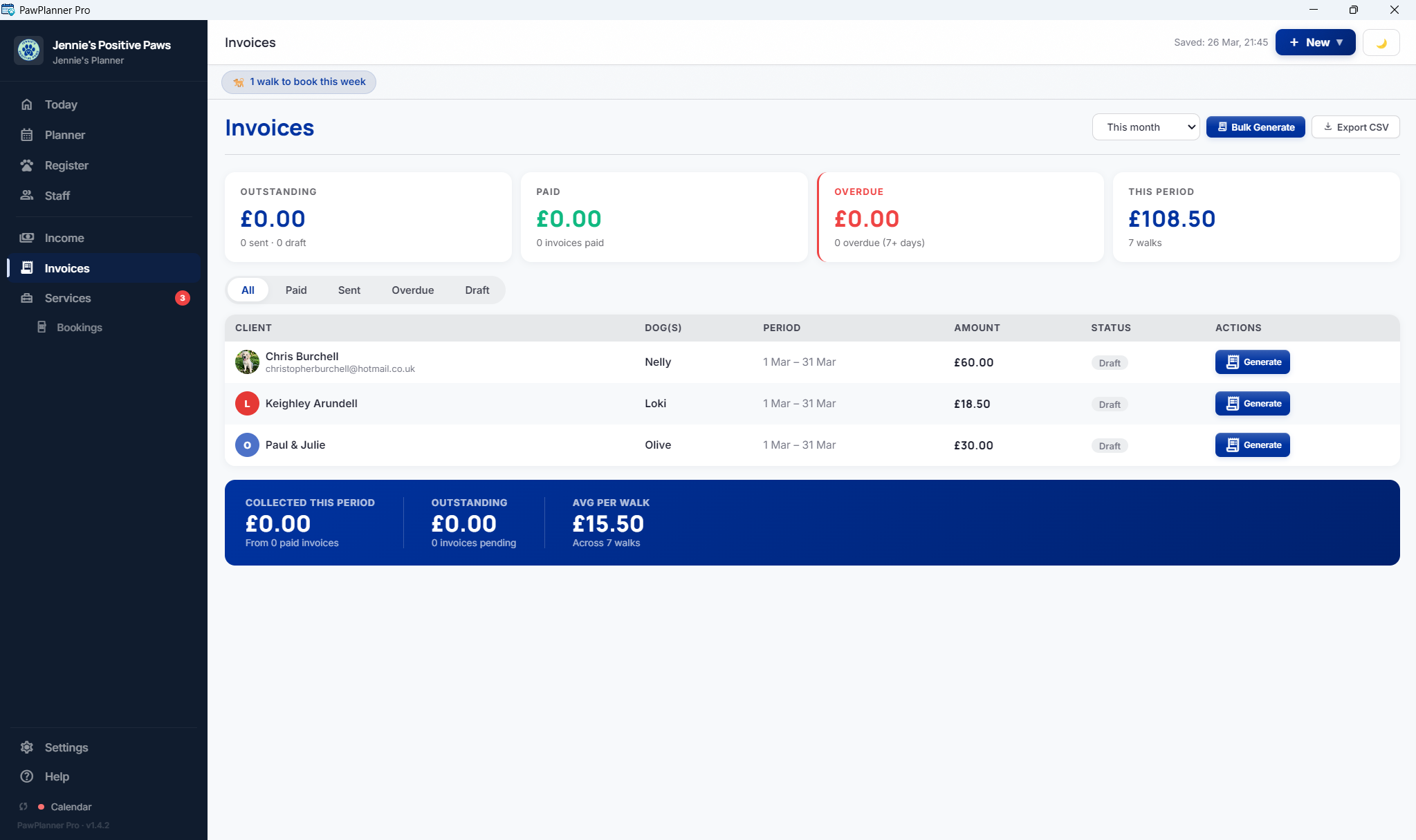
If invoicing sits completely apart from your planner, dog records, and client information, the admin takes longer than it should. You end up jumping between tools and reconstructing the week after the fact. That is manageable for a while, but it gets tiring.
This is one of the reasons Pack Planner Pro dog walking software was built to tie together scheduling, dog records, and income tracking. It does not replace every accounting tool, and it does not need to. It simply keeps the business admin connected enough that invoicing is not a separate headache.
Do not wait until tax time to tidy it all up
Most invoicing stress comes from delay. If your records are mostly accurate week by week, the year-end picture is usually manageable. If your invoices, notes, and payments are all half-tracked in different places, tax time feels much heavier than it should.
The aim is not perfection. It is clarity.
FAQ
What is a dog walking invoice?
A dog walking invoice is a record you send to a client showing the walks or services completed, the period covered, the total due, and the payment details.
What should I put on a dog walking invoice?
Your invoice should clearly show your business details, the client's name, an invoice number, the date, the service provided, the amount due, and how or when to pay.
Do I need to send invoices as a sole trader?
Many sole traders do, because it creates a clearer business record and makes payment expectations easier to manage. It is good practice even when full VAT invoice rules do not apply.
Should dog walking clients be invoiced weekly or monthly?
Either can work. The better option is whichever you can keep consistent and whichever your clients understand easily.
How long should I keep my invoices?
HMRC requires self-employed people to keep records for several years after the relevant tax deadline. Always check current GOV.UK guidance, but invoice records should form part of your normal record keeping from the beginning.