At a glance
A good price needs to cover the walk, the travel, the admin around it, and the shape of the week you are actually trying to run.
The common mistake
A lot of dog walkers underprice because they think about the hour itself but not the unpaid work and broken-up day that sits around it.
Most dog walkers ask the pricing question too late or in the wrong way. Usually it sounds like this: what does everyone else charge near me? That is understandable, but it rarely gets you to a number that actually works for your own business. Someone else may have different travel time, a different service mix, different family commitments, different group-walk setup, or a week that is far easier to stack neatly than yours.
A better question is this: what does each walk need to cover if the business is going to feel sustainable once the week gets busy? That pushes pricing away from copying and towards understanding the actual workload.
What actually affects dog walking prices in the UK?
Prices vary by area, of course, but location is only one part of it. A realistic pricing structure is shaped by several things at once.
- Whether the walk is solo or group
- How much travel sits around each job
- How easy the day is to stack without awkward gaps
- How much client communication and note-keeping the service creates
- Whether there are regular cancellations or changes to absorb
- What type of dogs, households, or logistics make the slot more involved
That is why simply matching someone else's advertised rate can be misleading. The number only makes sense inside the system that supports it.
Why new dog walkers often underprice
New dog walkers usually want to be reasonable, attractive to clients, and not appear too expensive. The trouble is that this often leads to pricing around the visible part of the job only. You see a half hour or hour-long walk and set a number around that. What gets missed is everything sitting around it.
Travel, messages, rearrangements, key handling, waiting between jobs, record keeping, and invoicing all belong to the business even if they are not paid as separate line items. If your price only covers the walk itself, you can end up busy but still feel like the business is dragging you along.
Should solo and group walks be priced differently?
Usually, yes. Solo walks and group walks create different handling and time pressures, so separate pricing often makes sense. The important thing is not following a rigid rule. It is making sure the price matches the work involved and is easy for the client to understand.
If a service is more involved, takes more one-to-one handling, or breaks the day up in a less efficient way, it usually deserves a different price. Clear structure is better than vague exceptions that you have to keep explaining client by client.
Price for the week you want, not just the booking you are looking at
A single booking can look worthwhile in isolation and still be awkward inside the wider week. This is the part people often miss. You are not pricing one walk. You are pricing a service business that has to function across days, routes, repeat clients, notes, invoicing, and the constant small changes that come with real clients and real dogs.
That is why pricing and scheduling are connected. If the week is badly structured, the business becomes harder to run no matter what the headline walk price says. If you want to get clearer on that side, the next useful read is how to organise your dog walking schedule.
Talk to potential clients before locking the structure in
It is worth speaking to potential clients and paying attention to what local people actually ask for. That does not mean letting every enquiry dictate your pricing. It means understanding which services people value, what they assume is included, and where you may need to explain your offer more clearly.
Those conversations also help you see whether the current pricing structure feels realistic for the market you want to serve. Sometimes the problem is not the number. It is that the offer itself is unclear.
Make pricing easier to live with by keeping the records cleaner
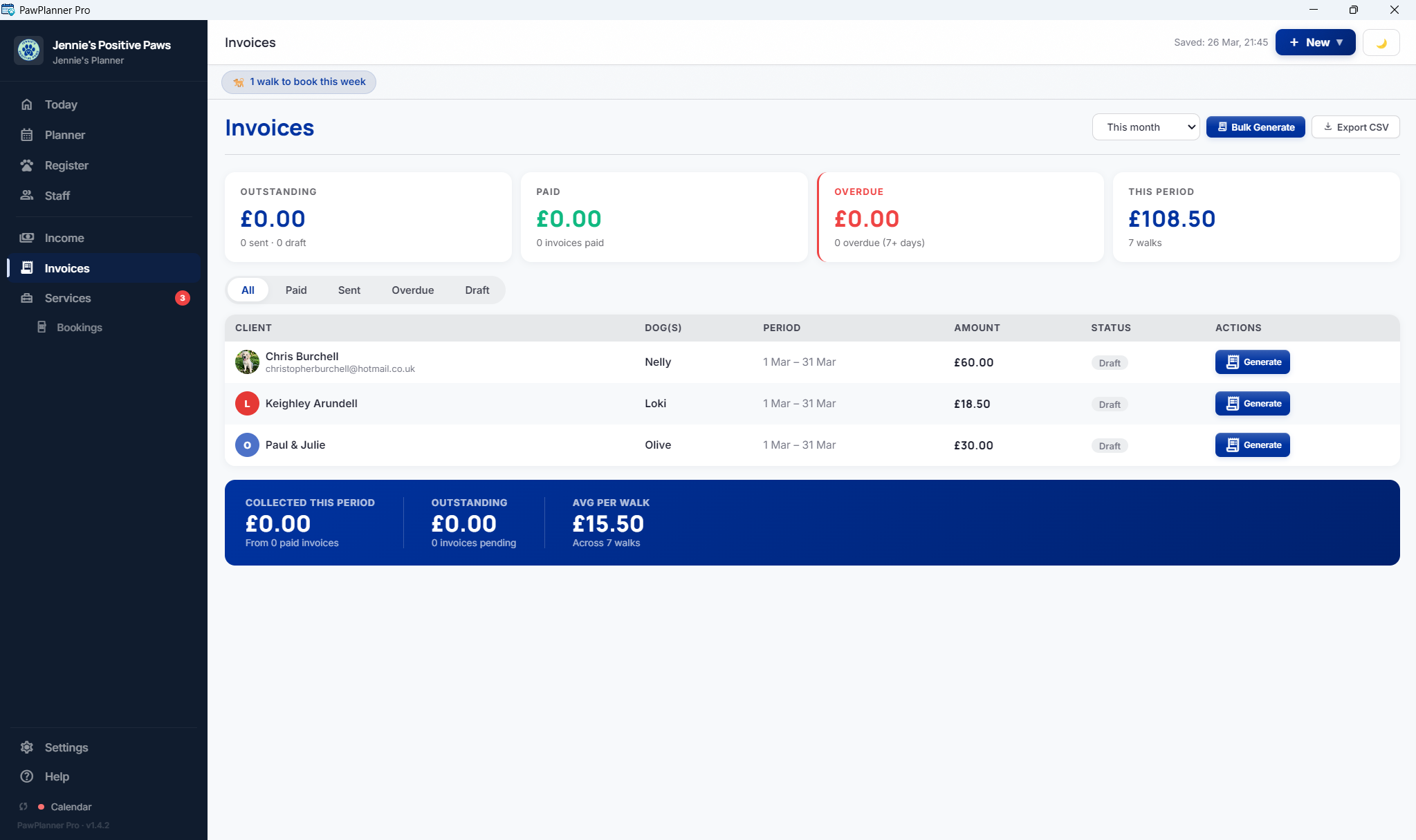
Pricing stress often turns into admin stress. If your services, walk notes, invoices, and week planning all live in different places, it is much harder to see whether the business is working at the current rates. That is one of the reasons connected systems matter. Clear records make it easier to see what has been done, what has been invoiced, and whether the business still feels viable at your current structure.
If you want help thinking through fit before buying anything, the safest next step is simply to get in touch. Sometimes a quick conversation makes the pricing and systems side much clearer.
FAQ
How much should I charge for dog walking in the UK?
There is no single universal number. The useful answer is to set a price that covers the walk, the travel, the admin around it, and the structure of the week you are realistically trying to run.
Should solo and group dog walks be priced differently?
Often yes, because the work involved is different. The price should match the handling, time pressure, and how the service affects the wider day.
Why do new dog walkers often underprice?
Usually because they price around the visible walk only and miss the unpaid work around it such as travel, messages, diary changes, and invoicing.
Should I talk to potential clients before setting prices?
Yes. Real conversations help you understand what local people are expecting and whether your offer is clear enough before you lock the structure in.